The Micro-Yes Blueprint: Three Ways to Get Yourself (And Your Team) Unstuck
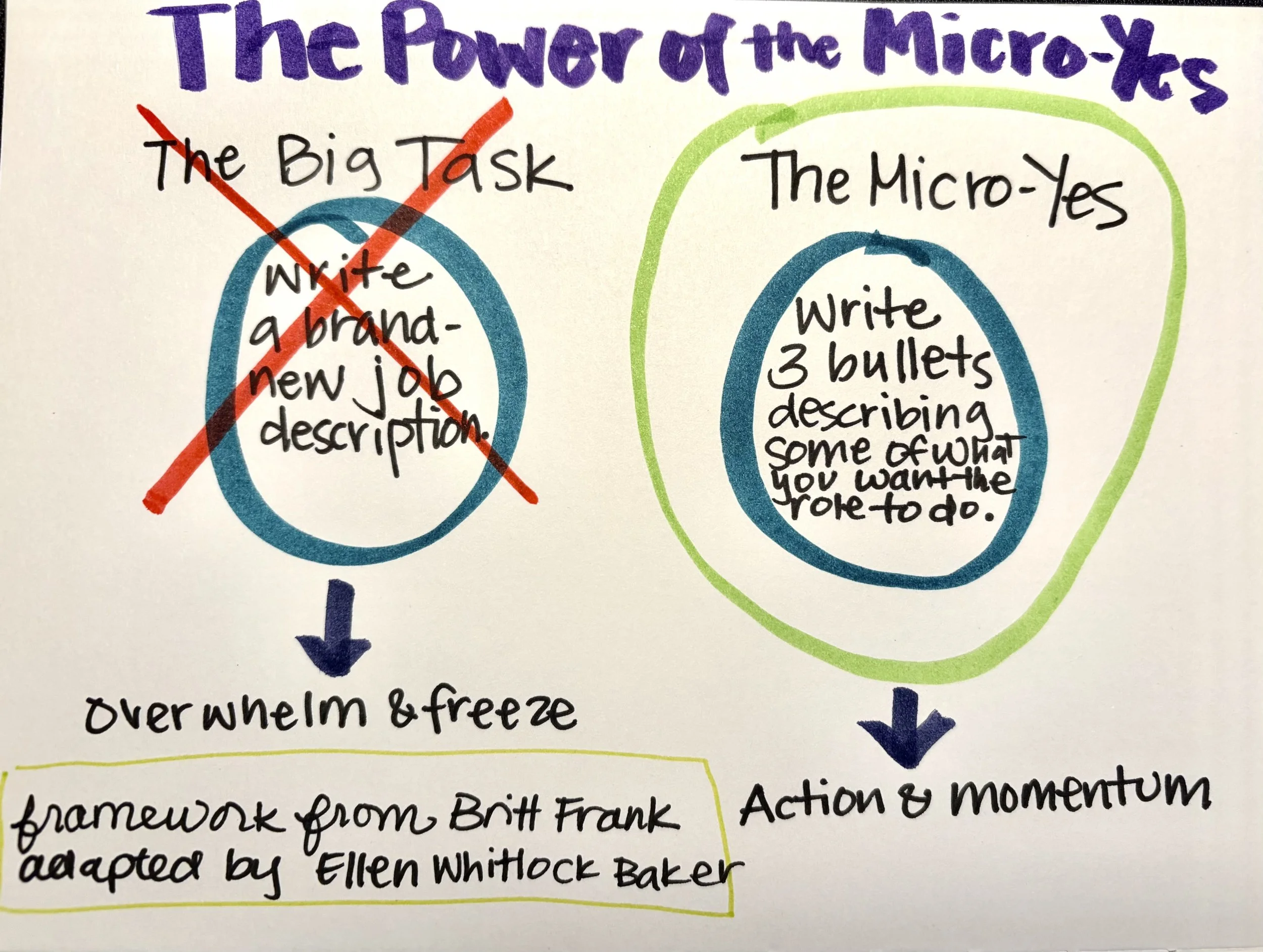
My diagram of the difference between trying to power through a big task all at once and breaking it up into small micro-yeses.
My client was stuck. She knew she wanted to take the next step in her career and apply for a VP-level role, but every time she sat down to overhaul her resume and research jobs to apply for, she got completely overwhelmed and froze.
“I don’t know why I can’t make this happen!” she told me. “I know what I’m supposed to do. I even have a list! But every time I sit down to try, I just can’t.”
I know this feeling well, and I bet you do too. It has a name: “functional freeze.” Our brains are wired to keep us safe, and too much change all at once, or too much to do all at once, feels unsafe. As Britt Frank pointed out when we spoke on Hard at Work, our brains aren’t hardwired for organizational performance or even happiness. They’re wired to protect us from perceived threat.
When leaders face massive actions, tasks, or changes, there are a lot of unknowns, and to the brain, that signals danger. That’s why we end up in analysis paralysis, delayed decision-making, and often, exhausted.
For my client, the massive amount of work it takes to find a new role, not to mention the big change and challenge that role would be, triggered that functional freeze.
We don’t have to stay frozen, and contrary to much of the popular work lore, we don’t have to “push through,” (aka forcing yourself to work on something scary when you’re already not in the best head space, which isn’t going to produce the best work).
Britt shared an excellent tool on the podcast, one I use all the time when I’m working with leaders and executive teams: the “micro-yes.”
Think of the micro-yes as the teeniest, tiniest step you can take in the direction of your big project or end goal. For my client, it was: every day I’m going to write down three things I either want in a new job or I definitely don’t want in a new job. By the end of a week, she had a pretty great pro/con list that helped us move onto the next micro-yes, which was making a list of people she could reach out to. Not contacting them yet, just making the list — that’s the micro-yes. Then you work on maybe contacting one person every couple of days.
The key to a micro-yes isn’t just making a task smaller – it’s making the first steps so ridiculously easy that the brain’s threat center can’t trigger a freeze response. What happens instead is that your brain has built up new neural pathways through your micro-actions and the change doesn’t feel so debilitatingly scary any more.
Action step: Think of one big deliverable you’ve been putting off this week. What’s the absolute smallest 'micro-yes' step you can take on it today?
To listen to the full episode of Hard at Work with Britt, head to your podcast platform of choice or you can find it here.